

Great Expectations

Not long after my little one’s diagnosis, I was at a gathering with a group of friends. One of the women there was a friend of a friend that I had not met before. She had a child with a ‘disability’ (sorry, I do not like that word) and was going through a divorce. We chatted for a bit, she asked about how things were going with my little one, and then she told me a statistic.

She said, “Did you know that around 80% of marriages where a child has a disability end in divorce?”

I politely said, “Wow”.

But in my mind there were several thoughts and reactions. First, I thought, “Well, isn’t that a bright and cheery statistic.” Secondly, I got fighting mad.

Divorce doesn’t ‘just happen’ and if the kid didn’t have enough to deal with, now they come from a broken home. Then I wondered what kind of stress does one parent put on the other; does parent #1 become resentful when parent #2 doesn’t do what parent #1 thinks parent #2 should do? All the while parent #2 is in a different stage of acceptance or understanding and has no idea why parent #1 is angry with them because they had no idea what parent #1 wanted in the first place. Whew!

Do you have expectations? Everyone does. Do you expect others to fulfill those expectations?

We all do that too. The problem comes when an individual gets resentful, angry, bitter, jaded. In last week’s article, I compare parents of children with differences to that of a team of Marines. Parents constantly fight the world from stealing their family’s happiness. Expectations can rob you of your happiness. Expectations can shift your focus away from your child, who matters, to a dirty bathroom, that doesn’t matter.

All that matters in this world is a kid’s wellbeing.

In truth, we control our expectations. We just have to be on guard from allowing our expectations to control us and rob us of happiness.
Overcome


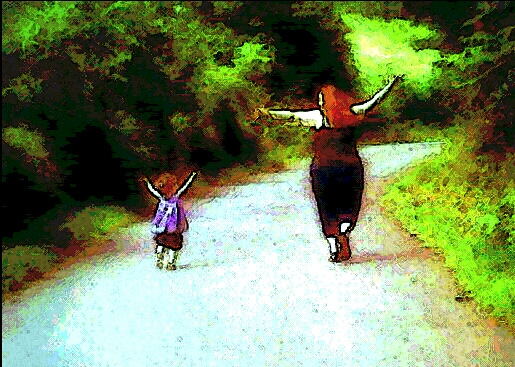
You may have noticed my first blog titles have had a pattern. Improvise. Adapt. And now, Overcome. This is the unofficial moto of the Marine Corps. What do you and a Marine in the field have in common? You, me, our kiddos… we are always in battle. Our battle is fear. Our battle is saving our family’s happiness. Our battle is overcoming ignorance. Our battle is ourselves. Our battle is life. Our battle is confusing, overwhelming, frustrating, and scary.

Our battle is for the welfare of our precious child.

What does the Marine in combat not have in common with you? He/She has a team. Most of us parents don’t have the support that comes with a unified force.

When our little ones came into our lives, hearing loss probably was not even on the radar of concerns. Worries of diapers, feedings, wipes, and daycare typically dominate the thoughts of most new parents-to-be. Being a new parent is like a battle in itself. Yet, when we then are ambushed with the diagnosis, we are attacked with fear and misconception. We are assailed with grief. We are bombarded with professional recommendations, family advice, our own and others ignorance, and short timelines. 

And it is our job to handle all this, without giving up, without letting our happiness get stolen, without our baby suffering.

How do you do this?

Well, each of us has a different journey but here are a few guiding principles:

  1. Fortify your mind – Gather all the information you can. Become knowledgeable. Prepare yourself.
  2. Command central – Your leadership is the most important in this mission. Are you and your spouse/partner on the same page? Is one afraid to tell the other what they think, fear, want? Does one have unreasonable and unvoiced expectations of the other?
  3. Unify – Keep your family included. Tell them your new knowledge. Your army has to know the mission, not all the details mind you, but enough to carry out the mission. You will find that the more comfortable you are with your knowledge and decisions, the less people interfere and the less others helpfulness tends to be irksome.
  4. What is the mission? To be strong for your child. To maintain and/or improve your family’s wellbeing. Always keep the mission in sight. Always make it a priority. Always fight for your family’s happiness.
  5. Look for reinforcements – find local groups. And those groups can be difficult to find, but look for them. Start with figures you may be familiar with, such as Marlee Matlin. Learn about her life, her struggles, her amazing successes, the charities she supports. Or Derrick Coleman. Or Beethoven. Or Bill Clinton (hard of hearing). Find groups like Hands and Voices, or use this list I found from Gallaudet. When you are comfortable, become a member, become active, become involved.   

Does this sometimes mean that you are bearing a heavy load? Yes.

Does this sometimes mean that you must make decisions you want to avoid? Yes.

Does this mean you get to sit and feel sorry for yourself? No.

You Improvise. You Adapt. You Overcome.

Because in the end, the greatest of these is Love.

Adapt

adapt

I’m gonna tell you a secret….shhhh…..

For my first 8 years of life, I lived in a 3 room house with no running water. Heat and air was a fireplace and a fan. The bathroom was an outhouse.

And….I LOVED it! The happiest memories of my life are laughing and playing outside and running inside for a nice drink of cool water from the water bucket, or falling asleep in my little blue chair in front of the fan, or having baths in a galvanized tub, or sitting in front of the fireplace at Christmas feeling so cozy and loved.

It wasn’t until 1st grade that I discovered not every kid had it as good as me. They had inside bathrooms, and water that came out of a faucet, and, the worst, air-conditioning!

Yes, I did know how to use regular facilities. We did have to leave the holler from time to time. Like the time my Mom, brother, and I rode a greyhound bus all the way to New York City to see my grandma. I still cannot fathom how my Mom travelled like that with a 4 year old and an 11 year old. I can honestly say I am not courageous enough to EVER try that.

For some reason growing up, I never felt like I had missed out on anything. When I’d go to a friend’s house for a sleepover, I was never envious of their finished house with carpet, central heat and air, and running water. Their homes were just different, some nicer than others, but different. I adapted to my surroundings.

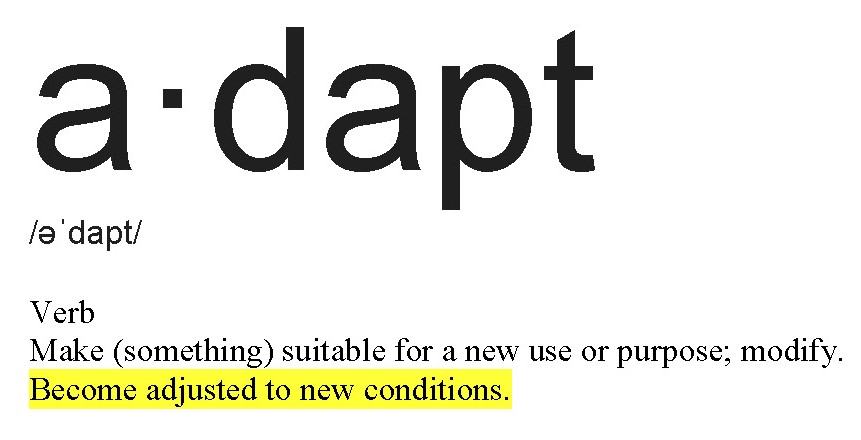
Adaptation is the fine art of adjusting to new conditions. And it truly is a fine art that later can be honed as a powerful skill. One thing I figured out right after I had my little ray of sun shine, is that kids are the absolute best at adapting. I remember just pondering how it was that kids were so expert at adaptation while for adults it can take a while. (I still do not know how to use a Mac Book, I’m all Windows) Then it hit me while I was playing outside with my little love; kids don’t know any more than what they have experienced!

This is a big concept, really. It seems so simple; it’s easy to overlook the true depth of this realization.

My little one was not born knowing that she could not hear.  I’ll repeat that.

My little one did not know that she could not hear.

Another HUGE realization: Our child didn’t have to adapt to our world, We had to adapt to hers.

She didn’t have the disadvantage. I did. Beyond cuddles, smiles, cries, and facial expressions, we couldn’t speak the same language. And I, being the adult with the ability to surf the web, had the responsibility to learn a language we could both understand. I had to adapt.

A person should not mourn what they never knew and they did not have.

My child was my second pregnancy but first baby. I did not know a life with a hearing child. Sometimes my husband and I are so thankful that she has prompted us to learn a new language, especially in loud situations or when our proper English turns a bit more like drunken sailors’.

Our expectations? We had none. We had hope. We had love. We had the ability to adjust to new circumstances. We believed our child was not ‘broken’ and she did not need ‘fixing’.

Just as when I was a child, I couldn’t mourn the fact we lived in a 3 room shack. I never knew an alternate until I was older, that my ‘normal’ was different from others. And I never learned shame because my parents did not teach it to me.

Later, I will write more about expectation and about embarrassment. But I will note that kids are not born with expectation, nor are they born with embarrassment.

Improvise

When I was a kid, I was the queen of ‘make-do’. If I couldn’t find a hammer, I’d use the heel of a shoe to drive in a nail. If I had no access to a drill, which in hindsight was probably a good thing, I’d use a screw and screwdriver to predrill a hole. If I couldn’t find curtains, I’d make curtains out of old fabric. No curtain rods? Well, push pins worked great. I remember playing baseball with my older brother using a 2×4 as a bat and blocks of scrapwood as baseballs. I also remember pegging him square in the forehead with a scrapwood block, which I thought was hilariously funny, but for some reason brought about the end of block baseball.
An ingenuitive kid WILL find a way to ‘make-do’. History, fiction, and literature are filled with some of the most entertaining stories of kids finding some way to make what they need. Instead of stopping their plans because they don’t have just the right tool, they find a way.
They improvise.
Kids naturally do this. Not every child to the same degree, but in some form, some way, all kids do it. My daughter does not have access to a real kitchen, with utility tools, oven, sink, microwave, etc. but she will pretend that all of those things are at her disposal when she is making a special imaginary creation from her pretend kitchen.
Kids don’t stop improvising unless their ideas are constantly hindered. Kids don’t give up, unless they are taught to give up.
A child doesn’t know that something is ‘wrong’ with them until someone they respect tells them that something is wrong with them.
A deaf or hard of hearing child has no idea what they don’t hear. And that is fine. They improvise. They compensate. They are little four year olds who look at a sunset and say, “That is pretty,” in sign language. They are the little 5 month old babies who see a happy smiling adult and give the biggest sweetest grin back. They are the kids who watch body language closely and can usually sense what hearing peers cannot.
Which means, parents, they watch you closely as well. Do you improvise? Do you ‘make-do’ until you can either find the right tool or finish the job? Are you one of the parents that refuse to give up no matter what obstacle is put in your path?
Learn from your kiddo, improvise.